Practice Trading: Backtesting, Paper Trading, and Live Trading

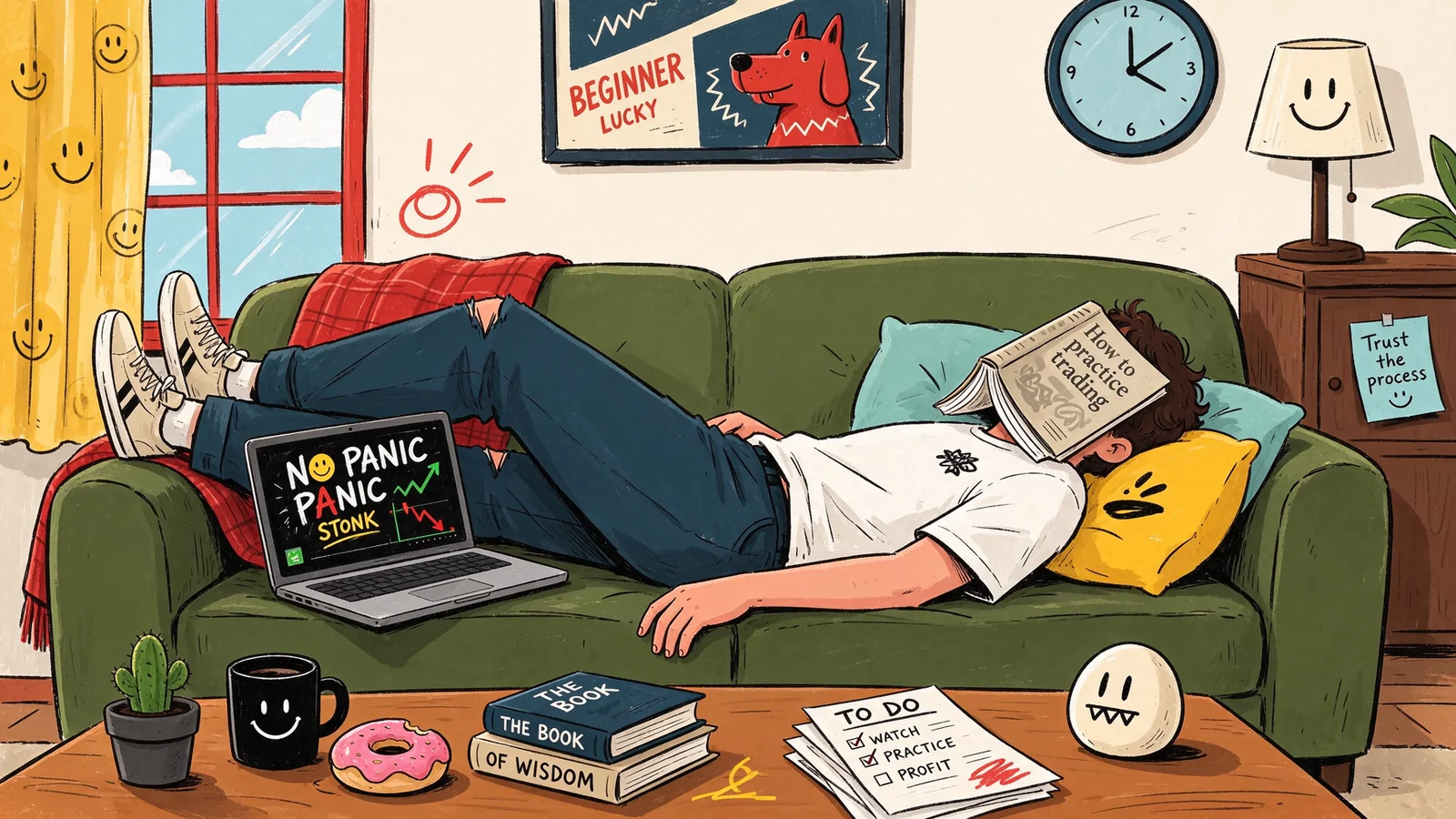
Most people meet trading in the same place: a chart, a small account, and a firm opinion about where the price is going next. Practice trading is how you find out whether the opinion survives contact with a chart. There are three ways to do it, and they are usually tried in the wrong order.
The three differ on two questions, and only these two:
- Is the price real and happening now, or is it history you already have?
- Is the money real, or is it a number in a box?
Two questions, three rooms. Backtesting is history and pretend money. Forward testing, also called paper trading, is real prices and pretend money. Live trading is real prices and money you can spend.
All three are practice trading. What separates them is which part of the job each one rehearses, and therefore what each can honestly teach you.
Backtesting: simulated trading on data that already happened
You open a chart from the past, hide everything to the right of a chosen date, and trade forward from there. The prices are real — they happened — but for you it is a rehearsal, because you cannot see what comes next.
What this is good at is repetition with a scoreboard. In one evening you can simulate trading a plan across five years of data and find out whether the idea made money over hundreds of trades, rather than the handful you would manage in a year of real trading.
Here is a made-up plan to make that concrete. Buy when the price closes above its highest close of the past 20 days. Sell when it closes below its lowest close of the past 10 days. Nothing else.
Run it over five years of one market, daily prices, and you might get about 35 trades. Say 14 of them made money and 21 lost. The winners averaged +2.4%, the losers −1.0%. Multiply it out:
- 14 winners × 2.4% = 33.6% won
- 21 losers × 1.0% = 21.0% lost
- Net: about +12%, before costs
A win rate near 40% and a positive result, which is worth noticing early: how often you are right and whether you make money are two different numbers, and the second one is the one that matters.
A backtest will also tell you the boring truth about costs. Every trade pays your broker a commission and crosses the small gap between the price you can buy at and the price you can sell at. On the example above, those costs might eat a quarter of that 12%. Traders who backtest without them are usually testing a different strategy from the one they will trade.
What simulated trading cannot tell you is how long 20 days is.
In a replay you can press "next" forty times in a minute. In real trading, the next day's close is a day away, and you have a job and a commute and a week where nothing happens. A backtest measures the plan. It says nothing about the person holding it.
Forward testing: paper trading on a real clock
Forward testing, or paper trading, is the same decisions with one thing changed: the prices arrive when they arrive, not when you ask for them.
You trade a demo account, or a spreadsheet, or a chart with a marker you move forward one day at a time. The money is still pretend. The uncertainty is not.
This is where beginners learn the parts of trading that no backtest contains:
- The waiting. A patient rule might produce three trades in three months. Two of them will feel like obvious mistakes while you are in them.
- The boredom. Nothing happens for a week, and then three things happen in two days, and the second one is the one you have to take.
- The disagreement between you and your plan. You will be tempted to skip a signal because the last two lost, and to take one that is not on your list because you have not traded in nine days.
That third one is the whole point. If you cannot follow the plan on paper, with nothing at stake, you will not follow it with money at stake. Paper trading is where that becomes visible while it is still free, which is the whole reason to do it before the money is real.
Write things down as you go: what you saw, what you did, whether the two matched, and how you felt while it happened. A forward test you did not journal teaches you almost nothing, because the only lesson it has is about your own behaviour, and behaviour is hard to remember accurately.
Expect it to be slow. A realistic forward test is a month or two for a first reading and several months before you have much of a sample. That slowness is not a flaw in the method. It is the same speed you will be trading at when the money is real.
Live trading: the same thing, with consequences
Live trading is forward testing with real money, and at first it does not feel very different. You have the same plan, the same signals, the same chart.
Then three things change.
The size is real. On paper, losing 1% of a $5,000 account is a number. Live, it is $50, and $50 is not a percentage of anything. It is dinner, or a book, or the amount you said you would not care about.
You cannot restart. A demo account resets, or you can quietly stop counting. A live account carries the last four weeks with it into the next trade.
You will break the plan. Not because you are weak, but because the reasons to break it only exist in real time: the position is open, the price is moving against you, and you have to decide whether your own rule is still right.
The gap between paper and live is smaller than people fear if the first two rooms were honest, and much larger if they were not. If your forward testing was three tidy trades you did not journal, live trading will be the first time you learn anything, and it will charge you for the lesson.
What each kind of practice trading tests
- A backtest tests the plan: does it survive hundreds of trades, and does it still work after costs?
- A forward test tests the plan under a clock, and then you against it.
- Live trading tests you with consequences, which is the only way to test that part, and the most expensive.
The order that costs the least
- Backtest until you can write the plan down in three or four sentences a stranger could follow. If you cannot describe it, you were not following a plan.
- Forward test for a month or two. Follow the written plan exactly, and write down every time you did not. If you keep breaking a rule, the rule is wrong for you — change it deliberately, on paper, before it costs anything.
- Go live small. Small enough that the first losing month is annoying rather than decisive. Size is a dial you can turn up later; it is much harder to recover from starting too high.
The most common way to fail at each stage is worth naming, because they are all cheap to avoid:
- Backtesting one idea, on one year of one market, and believing the result.
- Adjusting the rules after every losing run until the chart looks good. At that point you are not testing a plan, you are decorating.
- Paper trading without records, so three months pass and teach nothing.
- Breaking the plan during a forward test and concluding the plan does not work.
- Going live at a size you were never tested at, and finding out in public.
What none of them do
None of the three tells you what will happen next. The past is not a forecast, a demo account is not a guarantee, and a week of live trading is not a result.
What they do is answer different questions in a sensible order. The first tells you what your plan did over a great many trades. The second tells you what you do with a plan while the future is genuinely unknown. The third tells you both things at once, and charges you for the answer.
The first room is also the cheapest, and the only one you can walk into tonight: pick a chart, hide the right-hand side of it, and trade one bar at a time. That is what a replay in Tradebreath gives you — a trading simulator with the clock under your hand — and what the report at the end of the session is for: not to prove you will make money, but to show you, honestly and in numbers, what your decisions did. If you have never done it, the chart and replay walkthrough takes about ten minutes.