Best Stocks to Invest In Right Now

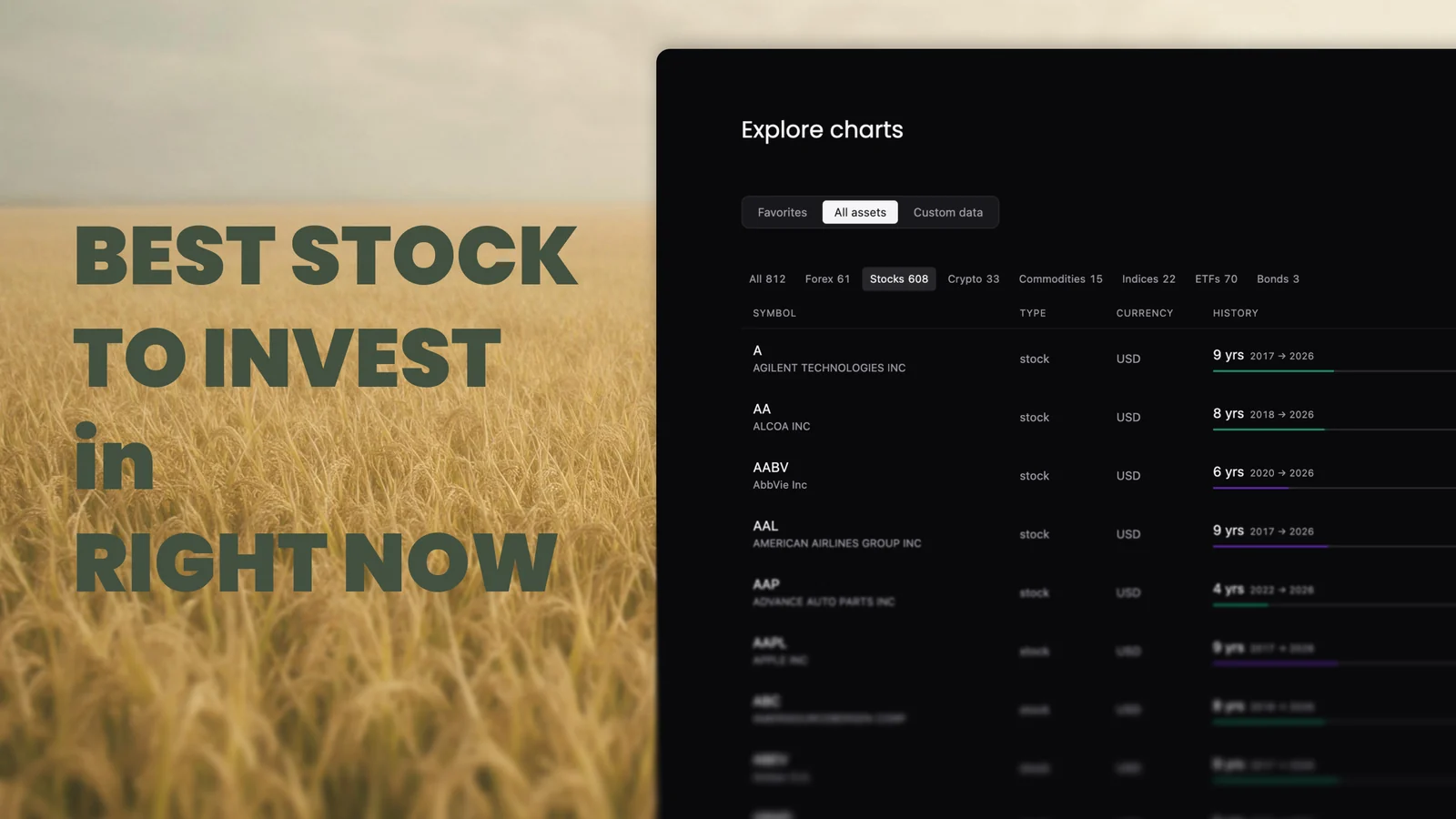
"Best stocks to invest in right now" is one of the most typed phrases in retail finance, and it is not a question anyone can answer for you.
Not because the people answering are all wrong. Because the question does not contain enough information to have an answer. It names one decision — which company — and hides the three that decide whether you make money: when you buy, when you sell, and how much you put on. Anyone who answers it anyway, confidently, with a ticker and a date, has something to sell: a subscription, an affiliate link, an audience, a position they already hold.
That is the first thing worth knowing. The second is more useful: the question is answerable once you change it.
Why the phrase cannot be answered
Three reasons, and they compound.
"Best" relative to what? A stock is not good or bad in the abstract. It is good or bad against a holding period, a risk tolerance and an exit rule. The same company can be a sensible ten-year holding for one person and a bad instrument for someone who needs the money in March.
"Right now" is a moment nobody can see. Every claim about the next move is a forecast, and forecasts come with no liability. The person who told you to buy does not carry your loss, does not know your account size, and will not be there when you decide to sell. The asymmetry is the whole business model of a stock tip.
The pick is the smallest part of the outcome. Two people buy the same stock on the same day. One holds through a 25% drawdown and sells at the bottom; the other takes the same drawdown with a rule that says what to do. They will have different results and neither of them will have been wrong about the company.
So when someone promises the best stocks to buy now, what they are really selling is the feeling of having decided. You can get the decision for free. The work is in the other three variables.
A stock is only "good" against a plan
Here is a test that costs nothing and changes how you read every list of recommendations. Take any name from any article and ask: under what rule would this be a buy, and under what rule would it be a sell?
If the answer is "buy it because it is going up" and "sell it when it stops going up", you have not been given a plan, you have been given a mood. A plan has a trigger, a size, a stop and an exit, and those four things are testable. The company is the setting; the plan is the decision.
That is also why two experienced traders can disagree about the same stock without either being wrong. They are running different rules on the same instrument.
The part that is actually knowable
You cannot know what a stock will do next. You can know a great deal about what it has already done, and that is the only honest input to a decision.
How does it behave in the hours after earnings? Does a trend in this name persist for weeks or reverse within days? How deep are its normal pullbacks — 3%, or 15% and back? What did it do in the last three corrections, and how long did it take to recover? Does it respect a moving average, or grind sideways for months and then move in one week?
None of that is a forecast. All of it is a description, and descriptions are what rules are built from. A strategy that works on a slow, mean-reverting stock is usually a bad strategy on a stock that moves in violent steps — same market, different animal.
This is where most conversations about "best stocks" would improve immediately. The interesting question is not which name, it is which behaviour, and behaviour is visible in the chart you already have.
Then test it, on that stock, before the money
Reading a chart and testing a rule are different exercises, and the gap between them is where most losses live.
Testing is what turns "this looks like it works" into a number you can argue with. The mechanical version is quick and unglamorous: pick the stock, pick a rule, run it over the last several years, and read what came out — win rate, profit factor, maximum drawdown, how the results were distributed across months.
You can also test it by hand, which is a different kind of useful. In Tradebreath you open a single stock, hide everything to the right of a date, and trade it forward bar by bar: you place the entry, the stop and the target yourself, with commission and spread taken off each fill, and you feel the part a backtest flattens — the waiting, the temptation to move a stop, the week where nothing happens. At the end there is a report on what you did, the same shape every time, so two sessions are comparable rather than two memories.
The two methods answer different questions, and the difference is worth stating plainly: a mechanical run tells you what the rule would have done across a thousand trades; a manual session tells you whether you can actually take those trades.
The fast version, if you want it
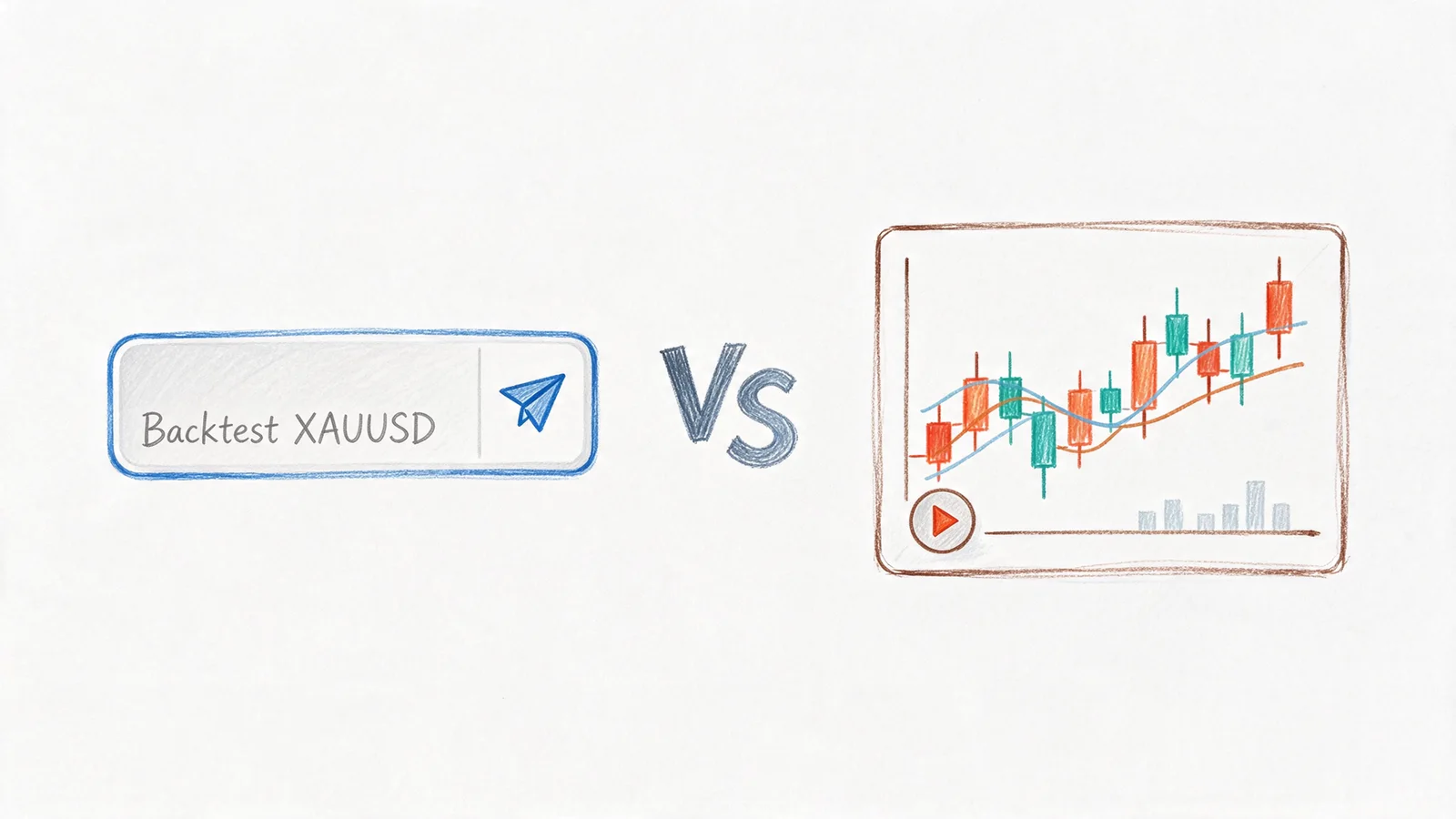
There is a shorter path when you have a sentence rather than a system. Describe the idea — "buy this stock when it closes above its 50-day average and sell when it closes below the 20-day" — and the copilot turns it into explicit, runnable rules, runs them over the stock's history, and hands back a report with the same figures as above.
Two things make that more than a novelty. First, the rules come back written out, so you can see whether the machine understood what you meant; the sentence "buy strength" is a wish, and the version it returns is a decision you can disagree with. Second, if you have already traded the stock by hand, it can work in the other direction: take your own session's trades, find the rule set that best explains your entries, re-run it, and tell you what share of what you did was a rule and what share was improvisation. Unmatched trades are kept and listed, because they are the interesting part.
Either way you end up holding a claim you can check instead of an opinion you inherited.
Entry is the question everyone asks; exit is where the money is
If you only test one thing, test the exit.
A made-up but ordinary illustration. Buy a stock whenever it closes above its 200-day average: 100 signals, half of them end in a gain, half in a loss. If the average win equals the average loss, the plan is a coin flip that pays commission. Nothing about the entry is wrong; the arithmetic is. Now change only the exit — let the winners run to 3× the average loss and keep the stop where it was — and the same entries, the same stock, the same period become a positive expectation before costs.
That is the whole argument for testing instead of picking. Your entry decides how often you are in the market. Your exit and your size decide whether being in it was worth anything. A mediocre entry with a disciplined exit beats a brilliant entry with no plan for getting out, and it does so reliably enough to measure.
Steadiness is not a smaller goal; it is the goal
Most people reading a list of "best stocks" are implicitly asking for the biggest number in the shortest time. That is the question that gets accounts closed, because the biggest number is usually accompanied by the deepest drawdown — and drawdowns end participation long before they end the strategy.
The trader who makes 8% a year with a 6% worst drawdown can keep doing it for twenty years. The trader who makes 40% and then gives back 45% stops after the second one. Both have the same skill; one has a rule that survives contact with a bad quarter.
So the number to look at is not the return at the end of the report. It is the shape of the line: how deep it went, how long it stayed there, and whether the result came from ten trades or from two lucky ones. That is what the drawdown figure, the daily calendar and the Monte Carlo pass on the report are for — not to flatter the result, but to answer "would this have been repeatable, or was it one good month".
A twenty-minute filter for any stock tip
Next time a name arrives with an urgent tone, run this before you do anything with it.
- What is the plan? Entry trigger, stop, target, position size. If any of the four is missing, you have a headline, not a trade.
- What is the sample? One chart pattern from one moment is an anecdote. Twenty years of that stock, or a rule that fired two hundred times, is evidence.
- What does this stock's own history say? Its drawdowns, its behaviour after earnings, whether trends persist in it at all. A rule that works on another instrument is not evidence about this one.
- Does it survive costs? Commission and spread on every trade, not just the good ones. A high-frequency idea usually dies here, and better here than in an account.
- What does the worst month look like? If you would abandon the plan during it, the plan is wrong for you regardless of its win rate.
None of those questions needs a subscription, and all of them can be answered in an afternoon.
What to do instead of asking for a ticker
The honest answer to "best stocks to invest in right now" is that the selection is the easy part and the naming is the hard part — not because good businesses are hard to find, but because a list gives you no plan, no exit and no reason to hold on the day it hurts.
What you can build instead is a process: a stock you have actually looked at, a rule that fits how it moves, a measured result over a real sample that includes costs and a bad quarter, and a size that lets you keep going through it. That process will not tell you which stock is best right now. It will tell you something better — whether the thing you are about to buy is something you can hold.