Prop firm challenge check
Would you pass a prop firm challenge? Judge a run or a replay against the firm's rules — target, daily loss, drawdown, trading days — before paying.
The prop firm challenge check takes the trades you already have — a backtest run, or a manual session — and judges them against a prop firm's rule set. Most traders find out which rule they broke only after they have paid for the challenge; this is the same reading, taken before the fee.
It is not a pass/fail generator for its own sake. The useful part is the sentence you get back: how far short you were, or which limit broke, and on which trading day.
Where to open it#
The same check is reachable from the three places your evidence already lives:
| Where | How |
|---|---|
| A recorded backtest | /backtests → open a run → Challenge, beside Report |
| A result in the chat | the result card's footer → Challenge |
| A manual session's report | /backtest/<id>/report → Challenge, beside Trades |
Nothing is submitted and nothing is stored: the check is derived from trades you already have, so it costs the same as opening the run.
The rules it reads#
Every number is a share of the balance the run started with, which is why no rule set carries an account size.
| Rule | What it measures | It fails when |
|---|---|---|
| Profit target | Net profit, as a percentage of the starting balance | The profit was not made |
| Max daily loss | The worst single trading day | Any day lost more than the allowance |
| Max drawdown | How far the balance fell below the rule set's reference | It went further than the allowance |
| Trading days | Days that carried at least one closed trade | Fewer days than the rule set requires |
| Best day share | How much of the profit came from one day | It is over the cap — a warning, not a breach |
Drawdown is either static or trailing, and the difference matters more than any other setting. Static measures from the starting balance: an account that is up 4% can lose 14% before a 10% limit is hit. Trailing moves the reference up with every new high, so the same 10% is measured from the peak — the strictest of the two, and the one many firms use.
The verdict names the day it broke#
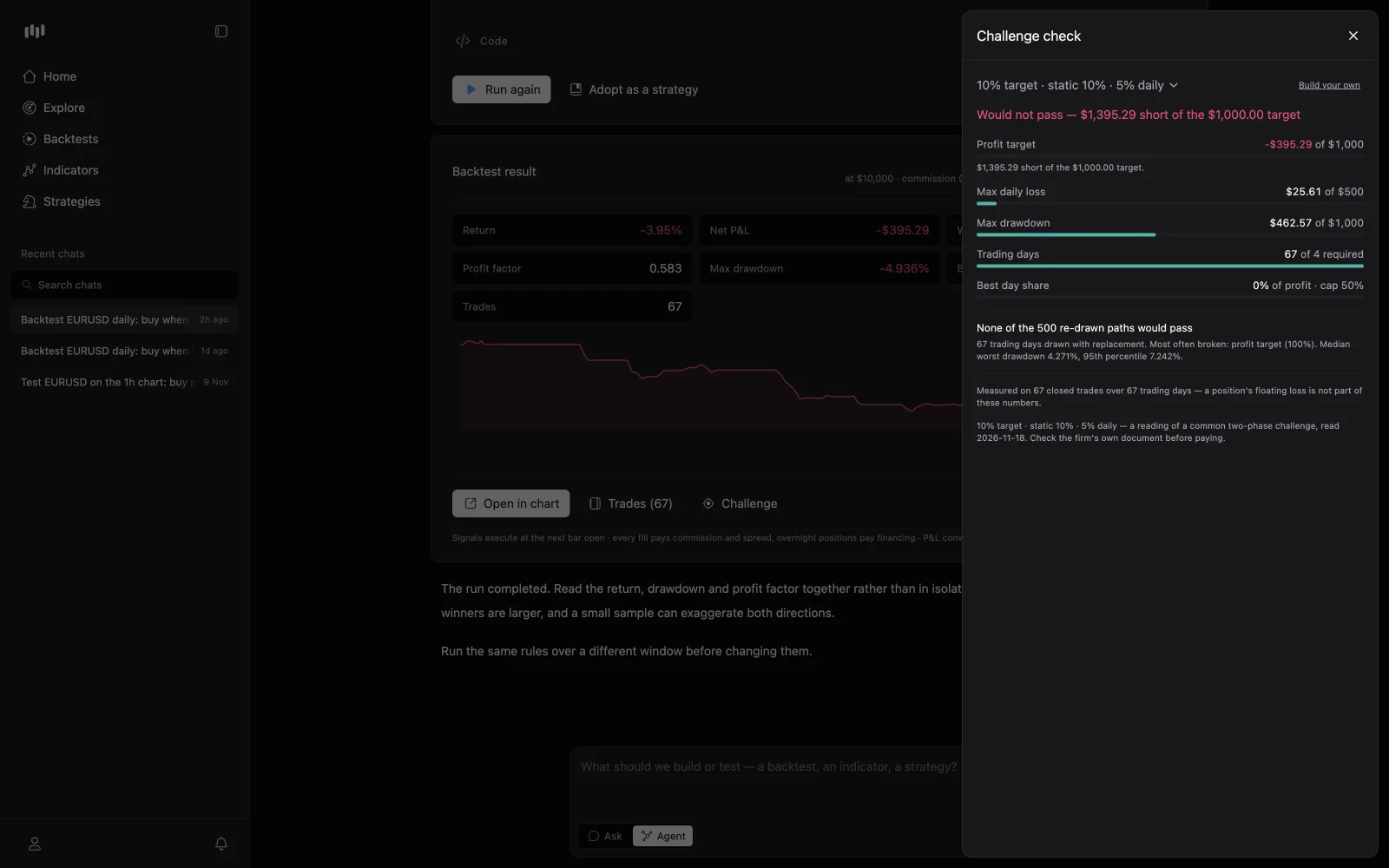
The headline is one sentence, and when a hard limit went first, it says which and when:
Would not pass — 2023-07-14 lost $5,310.00, over the $5,000.00 a day allows
The rule rows under it carry the two numbers each rule is about — where the account got to, and what it was allowed — with a bar for how much of the allowance was used. Only rules that need acting on get an extra sentence.
A challenge ends at the trade where both the target and the minimum trading days hold. Reaching the target on day three of a four-day minimum does not settle anything: the account stays live, and stays exposed to what it does on day four. When that happens the report says so and the trades after it are outside the verdict.
What the numbers are measured on#
The check reads closed trades. A day's loss is what the trades that closed that day settled at, so a position that was open and underwater all day does not move the number. The report states this under the rules, because a firm's daily limit is usually read on equity and a check that hid the difference would be selling a stricter verdict than it can support.
Trading days are cut in the rule set's own timezone — GMT+2/+3 for the presets, which is where most firms' servers run. A trade closed at 23:30 UTC and one at 01:00 UTC belong to the same day for such a firm, and to different days for a UTC rule set.
If the plan stopped the backtest early, the report says so rather than letting you read a short run as a losing one:
This run stopped at 10 trades, the plan's limit per backtest
— the check read that shorter period.
Would another order of days have passed?#
Under the rules there is a second reading: the same trading days are drawn again, with replacement, five hundred times, and each drawn path is judged by the same rule set.
None of the 500 re-drawn paths would pass
67 trading days drawn with replacement. Most often broken: profit target (84%).
Median worst drawdown 4.672%, 95th percentile 7.288%.
Days are the unit, not trades. A trade belongs to a day, and a daily limit is read per day — shuffling single trades would scatter them across days and judge the rule set on a calendar that never existed. Drawing whole days keeps every day's own loss exactly as it was; what changes is the order the days arrived in.
This is not a forecast. A drawn path is a re-draw of the days you already traded, so it says how much of the result sat on the order those days came in. It cannot say anything about days the run did not trade. Fewer than five trading days and the reading is hidden, because a re-draw of that little is noise.
Your own firm's numbers#
The three presets are readings of common rule sets, named for their rules and served with the date they were read. A specific firm's document rarely matches them, so Build your own lets you type that firm's numbers:
- target, daily loss and drawdown, in percent
- whether the drawdown is static or trailing
- the minimum trading days
- the best-day cap, or blank for none
- the clock trading days are cut in
The rule set is saved to your account, not to this browser, so it is there on another device. It is cited in the report with the day it was saved — which is the date to compare against the firm's document when something looks wrong. Up to twelve can be kept; Edit reopens the same form, Delete forgets one.
How to read a result you like#
- Passing is not the goal; passing twice is. Run the check on two windows of the same strategy. If one passes and the other breaks a limit, the strategy is fitted to a period, not ready.
- Read the drawdown, not the target. The target is the part you can feel; the drawdown is the part that decides whether you survive to reach it.
- Watch the re-drawn paths. A check that passes with nine paths in ten is a different proposition from one that passes with six — and the second is what a fee is being spent on.
- A daily limit broken early usually means position size, not strategy. The entry is fine; the size is what put the day over the allowance.
None of these is a verdict. They are reasons not to treat one passing check as a stable edge.
Next#
How the runs behind this are compared with each other: “Backtest runs and comparison”.